

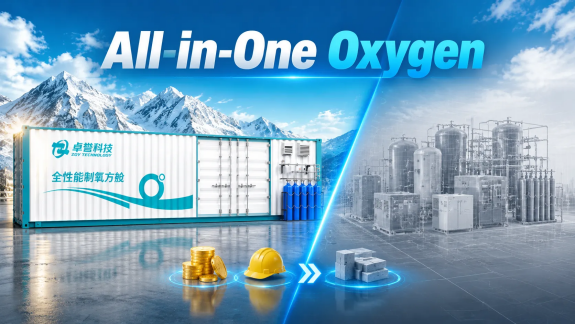
When hospitals compare two PSA oxygen systems, the equipment quotation is usually the easiest part to compare.
The more interesting question often comes later:
How much work is still left after the equipment arrives on site?
A split-type PSA system is not necessarily difficult to install. Experienced oxygen equipment suppliers often provide installation, commissioning and training as part of the package. UNICEF’s procurement specifications, for example, include installation, commissioning and training for both skid-mounted and containerized PSA systems. [1][2]
So the real difference is not simply split versus integrated.
It is how much of the engineering has already been completed before the system reaches the project site.
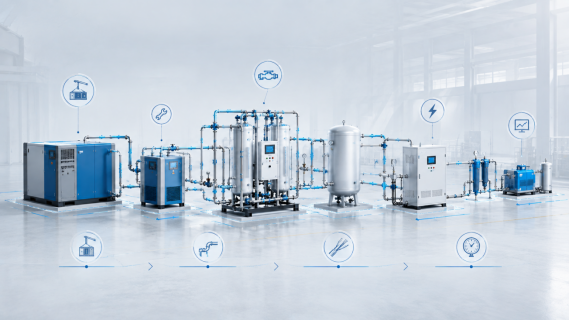
With a conventional split arrangement, components such as the compressor, dryer, PSA unit, storage tanks and control equipment are installed as a complete system on site. Depending on the design, some positioning, piping, wiring, connections and commissioning work still has to be completed locally.
In a well-equipped hospital with experienced technical resources, this may be straightforward.
In a remote overseas project, however, transport, skilled labor and local engineering resources can be much harder to coordinate. In those environments, reducing site work can have a very different economic value.
The value of an all-in-one PSA system is relatively simple:
More engineering is completed at the factory, and less is left for the site.
Equipment can be arranged, internally connected, wired, controlled and tested before shipment. The customer still needs to complete the external connections and commissioning required by the project, but there is less equipment-side integration to handle after delivery.
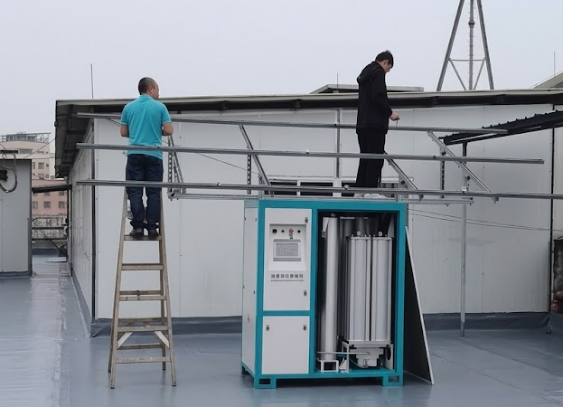
That can reduce the amount of site assembly and technical coordination required.
This matters particularly when the oxygen system is being deployed far from major cities or established engineering networks. A delay does not only mean losing a day of installation. It can also mean additional transportation, accommodation, labor and equipment-hire costs, especially when specialist personnel need to travel back to site.
The question, therefore, is not whether a split system can be installed efficiently.
It can.
The question is:
How much site engineering does this particular project need to pay for?
A peer-reviewed study of PSA oxygen systems implemented in Kenya, Rwanda and Ethiopia provides a useful illustration of why this matters.
Its whole-life-cycle cost analysis did not look at the PSA plant alone. Capital costs included the plant itself, generators, infrastructure, electrical work, installation labor, piping and manifolds, shipping, training, spare parts and other supporting requirements. The study also describes how land and buildings had to be provided for the oxygen plants in the projects. [3]
This is important because an oxygen project is rarely just an equipment purchase.
The machine is only one part of the installed system.
For projects in resource-constrained markets, reducing the amount of work that has to happen after delivery can therefore have real value. The more complete the system is when it arrives, the more the local team can focus on the connections that genuinely have to be completed on site—such as power, external oxygen piping and final commissioning.
That is where factory integration starts to become an economic decision rather than simply a product-design preference.
Containerized PSA systems take this concept one step further.
Instead of delivering the oxygen equipment and then building a conventional plant room around it, the generation system and supporting equipment can be integrated into a dedicated technical container before shipment.
UNICEF’s procurement specification for a 250 LPM PSA package provides a clear real-world example. The system is integrated into a 20-foot equipped technical container and includes equipment installation, electrical and pneumatic connections, start-up, testing, training and handover by the supplier or its regional partner. [2]
This does not mean that a containerized system requires no site work.
It means that a substantial part of the infrastructure has already travelled with the equipment.
That distinction matters.
Depending on the project design and site conditions, a containerized system can reduce or avoid the need for a conventional dedicated plant room. Instead of spending significant time constructing a space first and then installing the oxygen equipment inside it, the project can deploy a prepared technical unit on a suitable site and connect it to the required utilities.
The container is no longer just packaging. It becomes part of the infrastructure.
For remote hospitals, clinics and other projects where construction resources are limited, this can fundamentally change the installation equation.
| Cost & Labor Scope | Split-Type / Conventional PSA | Integrated / Containerized PSA |
| Equipment arrangement | Separate equipment units or assemblies | Factory-integrated equipment package |
| Internal piping & wiring | More equipment-side assembly may be required on site | More integration completed in factory |
| Site installation | Equipment positioning and system integration | Reduced equipment-side integration |
| Plant-room construction | May be required depending on site design | Containerized design can reduce or avoid dedicated construction |
| External power | Required | Required |
| Hospital oxygen pipeline | Required when applicable | Required when applicable |
| Commissioning | Required | Required, with more factory integration completed beforehand |
The difference becomes more meaningful as the project environment becomes more challenging.
Where skilled contractors, transportation and suitable infrastructure are readily available, conventional installation may be relatively easy to manage.
But when a project is remote, construction resources are limited, logistics are difficult or the deployment window is short, reducing site engineering becomes a direct project advantage.
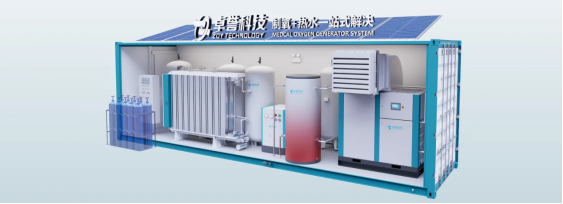
This is the engineering logic behind ZOY Technology’s integrated oxygen systems and Full Performance Oxygen Container.
The objective is not simply to place several oxygen components into one cabinet or container.
It is to complete more of the system integration before the equipment reaches the customer—equipment arrangement, internal connections, control systems and supporting infrastructure are designed as one operating unit.
For overseas projects, that matters.
The more work that can be completed, tested and verified in a controlled factory environment, the less the project has to depend on what is available at the destination.
And for a containerized system, the advantage goes one step further: the equipment enclosure itself can become part of the project’s infrastructure, potentially reducing the need for conventional plant-room construction.
That is the real value of an integrated oxygen system: moving more engineering away from the project site and into a controlled manufacturing environment.
In the right project environment, yes—particularly when site engineering, construction and logistics are significant cost factors.
The saving does not come from making installation disappear.
It comes from reducing the amount of assembly, integration and construction that has to be completed after delivery.
For overseas hospitals, remote clinics, mining sites and other infrastructure-constrained projects, that can mean fewer site operations, less dependence on local technical resources and a shorter path from delivery to operation.
So when comparing two PSA systems, don’t stop at the machine quotation.
The Smart Procurement Formula
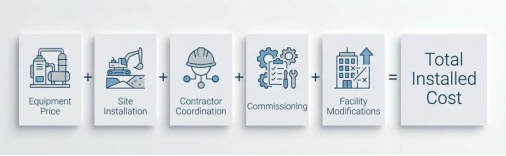
Always compare the cost of getting oxygen into operation, not just the price on the machine crate.
[1] UNICEF Supply Division — PSA Plant, 300 LPM Package, Skid
Official UNICEF procurement specification for an 18 Nm³/h skid-mounted PSA oxygen plant. The specification includes installation, commissioning and training.
UNICEF Supply Division – S0004071
[2] UNICEF Supply Division — PSA Plant, 250 LPM Package, Container
Official UNICEF procurement specification for a 12.5 Nm³/h containerized PSA oxygen plant integrated into a 20-foot technical container, including installation, commissioning and training.
UNICEF Supply Division – S0004055
[3] Smith V, Changoor A, McDonald C, et al. “A Comprehensive Approach to Medical Oxygen Ecosystem Building: An Implementation Case Study in Kenya, Rwanda, and Ethiopia.” Global Health: Science and Practice, 2022;10(6).
Peer-reviewed study examining PSA oxygen systems in Kenya, Rwanda and Ethiopia, including whole-life-cycle costs and the infrastructure, electrical, installation, piping, shipping and training requirements associated with deployment.
Full article – PMC9771461
10-16-2026
How to Verify a Chinese PSA Oxygen Generator Manufacturer Before You PayYou receive three quotations for a PSA oxygen generator from China. One offers a lower price, another promises faster delivery, and all three suppliers claim to be manufacturers. Their brochures look professional, their specifications seem similar, and each has photos of factory workshops and overseas projects. So, how do you decide who you can actually…
09-24-2026
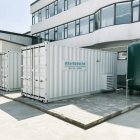
New Oxygen for the “City of the Sage” | Two ZOY Full-Performance Oxygen Shelters Installed at Qufu Second People’s HospitalQufu is known as the hometown of Confucius and the “City of the Sage in the East.” For more than two thousand years, this city has been shaped by Confucian culture and the idea of “benevolence toward others.”That spirit is still very much part of everyday life here. And today, it is also reflected in…
09-24-2026
Is It Cheaper for a 50-Bed Clinic in Africa to Refill Oxygen Cylinders or Install a Small On-Site PSA Generator?Why use a 50-bed clinic as the example? Because it sits in an interesting middle ground. A very small clinic may consume too little oxygen to justify its own production system, while a large hospital has more obvious reasons to build dedicated oxygen infrastructure. Around 50 beds, however, the question becomes much more practical: Is…
Submit Request