

Content Introduction: What does a turnkey containerized medical oxygen plant really cost? Explore public price references, hidden project costs, and real hospital experience from ZOY Technology.
Imagine you're planning a new oxygen supply system for a hospital. You receive two quotations. Both promise reliable medical oxygen, and both use PSA technology, but the prices are significantly different.
Why? The difference may lie in the equipment supplied, the services included, or the work left for the hospital to arrange.
For hospital decision-makers, this is where the real cost discussion begins. The price of a medical oxygen plant is not just the price of making oxygen. It's the cost of delivering a system that meets the hospital's needs, works reliably, and remains practical to operate.
There is no single price for a turnkey containerized medical oxygen plant. Capacity, equipment configuration, cylinder-filling requirements, installation conditions, and the scope of delivery can all affect the final quotation.
Public procurement listings provide a useful reference. For example, UNICEF Supply Division lists the following indicative prices for two containerized PSA oxygen packages:
| Procurement package | Indicative price |
| 250 LPM package | US$290,185 |
| 530 LPM package | US$333,804 |
Sources: UNICEF 250 LPM package and UNICEF 530 LPM package.
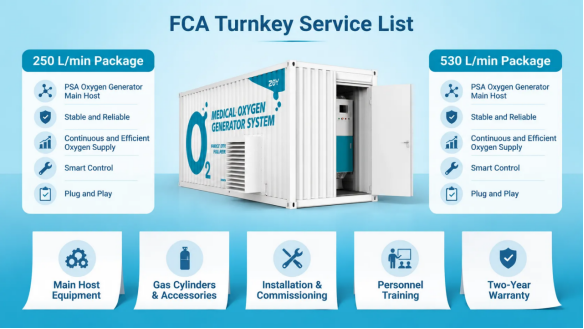
These are specific procurement packages, not average market prices or quotations from ZOY Technology. Both include more than the oxygen generator itself, with components such as cylinder-filling equipment, backup manifolds, cylinders and accessories, installation, commissioning, training, and a two-year warranty. The listed prices are indicative FCA prices, and the exact scope and current pricing should be confirmed with UNICEF.
This illustrates why two apparently similar oxygen plant quotations can differ considerably. One supplier may quote the core generation equipment, while another may include additional equipment and project services. Site preparation, external utility connections, shipping, and other work may also affect the final project cost, depending on the contract.
A turnkey quotation is only meaningful when you know exactly what is included—and what remains outside the scope.
The initial price, however, is only one part of the calculation. Electricity consumption is another important expense, alongside routine maintenance, replacement parts, and technical support. For a hospital operating its oxygen plant for many hours each day, these recurring costs deserve attention before the purchase decision is made.
For a PSA oxygen plant, electricity is one of the main ongoing operating expenses. Actual consumption depends on factors such as oxygen demand, equipment configuration, compressor performance, operating hours, and site conditions.
That is why buyers should compare more than the equipment price. They should also ask for power-consumption data under comparable operating conditions and consider how the proposed system will perform against the hospital's expected demand.
Depending on the project, energy-conscious configurations may include variable-speed compressors, appropriately sized equipment, photovoltaic power, or waste-heat recovery. These options serve different purposes: some can reduce electricity drawn from the grid, while others can make use of energy that would otherwise be wasted.
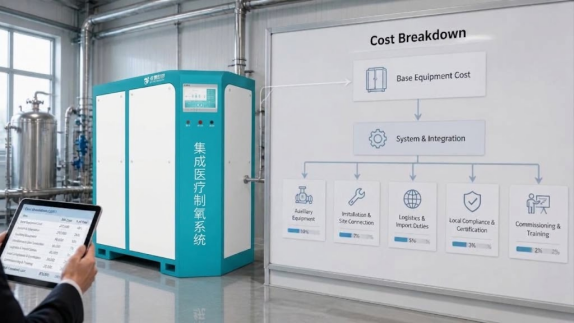
Not every configuration is suitable for every hospital. The value of photovoltaic power depends on solar availability and the relationship between generation and demand. The benefit of waste-heat recovery depends on whether the recovered heat can be used effectively. Compressor and system choices also need to match the actual oxygen requirement.
For this reason, energy-saving claims should be supported by measured or technically substantiated data, rather than assumed from the presence of a particular feature.
The purchase price tells you what you pay upfront. The system's power requirements help determine what it costs to keep producing oxygen.
Real hospital projects show how oxygen plant costs are shaped by the equipment configuration and the wider system design.
At Red Maple Hospital in Changsha, Hunan Province, China, the hospital initially used a 5 Nm³/h oxygen system. It later replaced that system with a 20 Nm³/h ZOY Full Performance Oxygen Container, then added a second 20 Nm³/h unit. The two newer systems now provide a combined capacity of 40 Nm³/h.
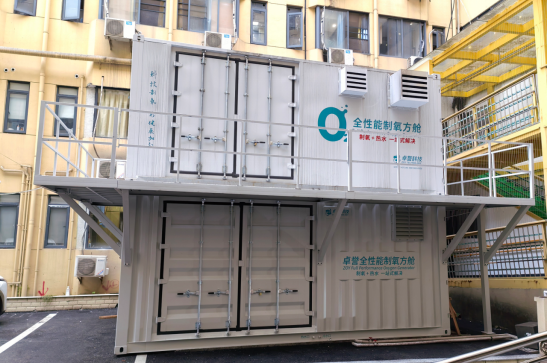
This case highlights why oxygen plant quotations need to be assessed against the actual project requirements. Capacity, equipment configuration, and the scope of the supplied system all affect what a hospital receives—and what the quoted price covers.
When evaluating the initial investment, buyers should also consider how the system can be expanded if oxygen demand increases. Can additional equipment be integrated into the existing setup, or would expansion require substantial reconstruction or replacement of existing infrastructure? A system that allows practical expansion may help avoid unnecessary duplicate investment and reduce the risk of turning earlier infrastructure spending into a sunk cost.
A different approach to operating costs can be seen at Hunan Children's Hospital, where ZOY's low-carbon oxygen station combines oxygen supply with photovoltaic power and waste-heat recovery.
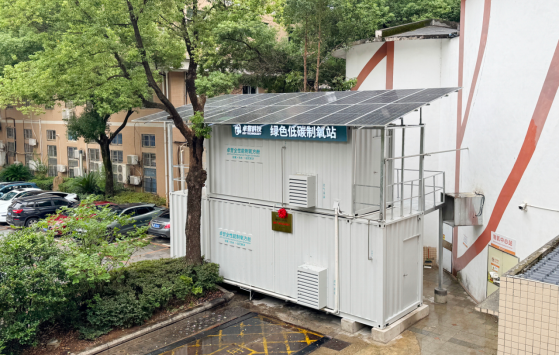
Photovoltaic power can contribute electricity when solar generation is available. Recovered heat can be used to warm water through the relevant heat-recovery and piping system. Bringing these functions into the station design allows energy use to be considered alongside oxygen production.
The actual financial impact depends on the installed configuration, operating hours, local electricity tariffs, and how much recovered energy can be put to practical use. Without verified performance figures, it would be misleading to assign a fixed saving or payback period to the project.
The key point is that these configurations need to be assessed as part of the proposed system, with their costs and expected benefits understood before the project is finalized.
Before choosing a supplier, ask five practical questions:
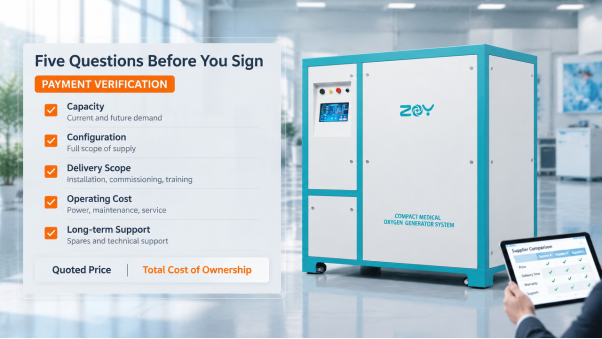
These questions help turn two different quotations into a fair comparison. They also make it easier to identify costs that might otherwise appear only after the project begins.
A turnkey containerized medical oxygen plant is a long-term infrastructure investment. Its real cost depends on what is supplied, how the system fits the hospital, and what it takes to keep it operating.
Public procurement prices provide useful reference points, while ZOY's projects in Changsha and at Hunan Children's Hospital offer practical examples of equipment configuration and energy-conscious system design.
For hospitals evaluating suppliers, the most useful quotation is not necessarily the cheapest one. It is the one that clearly defines the equipment and services included, identifies any additional project expenses, and provides a realistic basis for assessing operating costs.
The right question isn't just “How much does the plant cost?”
It's “What exactly does this price cover—and what will it cost to operate the system?”
10-22-2026
How Efficient, Reliable, and Sustainable Can Medical Oxygen Generation Be? ZOY Showcases the Answer at CMEFAt the 94th China International Medical Equipment Fair (CMEF), held at the Capital International Exhibition & Convention Center in Beijing on October 21, ZOY brought its medical oxygen generation technology to life with a live demonstration at Booth A2N35. Rather than relying solely on product displays and technical brochures, ZOY invited healthcare professionals, hospital administrators,…
10-16-2026
How to Verify a Chinese PSA Oxygen Generator Manufacturer Before You PayYou receive three quotations for a PSA oxygen generator from China. One offers a lower price, another promises faster delivery, and all three suppliers claim to be manufacturers. Their brochures look professional, their specifications seem similar, and each has photos of factory workshops and overseas projects. So, how do you decide who you can actually…
09-30-2026
Does an Integrated “All-in-One” Oxygen Machine Really Save on Installation and Engineering Costs?When hospitals compare two PSA oxygen systems, the equipment quotation is usually the easiest part to compare. The more interesting question often comes later: How much work is still left after the equipment arrives on site? A split-type PSA system is not necessarily difficult to install. Experienced oxygen equipment suppliers often provide installation, commissioning and…
Submit Request