

One of the biggest misconceptions about PSA oxygen generation is that achieving 93% ±3% oxygen purity means a system is suitable for every project.
In tropical regions, environmental conditions often become the defining factor in long-term system performance.
Real-world experience tells a different story.
| Tropical Operating Challenge | Engineering Impact | Climate-Adapted Design |
| High ambient temperature (45°C+) | Higher compressor discharge temperature, increased power consumption | Optimized airflow, intelligent forced ventilation, efficient cooling management |
| High humidity (up to 90% RH) | Excess moisture entering PSA process, molecular sieve degradation | Multi-stage air pretreatment, refrigerated drying, deep desiccant drying |
| Continuous 24/7 operation | Higher thermal accumulation and equipment stress | Stable thermal control, intelligent PLC monitoring, preventive protection |
| Remote installation environments | Difficult maintenance and unstable infrastructure | Integrated modular design, remote monitoring, simplified maintenance |
These conditions highlight an important engineering principle:
Reliable oxygen generation begins with adapting the system to the environment—not simply producing oxygen.
Many buyers compare oxygen purity, flow rate or compressor power.
Experienced engineers often begin somewhere else:
Compressed air quality.
According to ISO 8573-1, the compressed air entering a PSA oxygen generator must meet strict cleanliness requirements. ISO 7396-1 and the WHO Technical Specifications for PSA Oxygen Plants also emphasize that stable air pretreatment is essential for reliable medical oxygen production.
Excessive moisture is one of the greatest threats to long-term PSA performance.
At 45°C and 90% relative humidity, intake air contains more than four times as much moisture as under standard conditions.
If this moisture reaches the zeolite molecular sieve, it gradually occupies the adsorption sites that should capture nitrogen. This phenomenon—often called molecular sieve poisoning—reduces oxygen purity, increases energy consumption, and can permanently damage the adsorption bed.
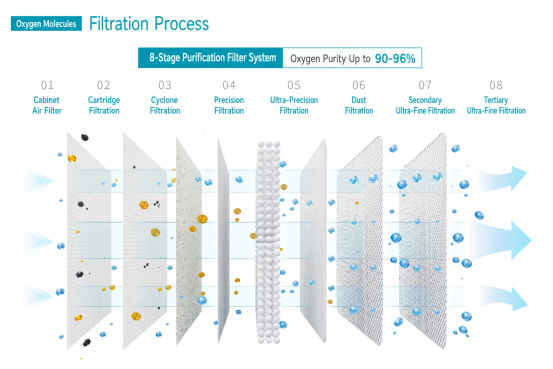
For this reason, climate-adapted PSA oxygen systems use far more than a standard refrigerated dryer.
A complete air treatment system typically includes:
Temperature creates another challenge.
As ambient temperature rises, compressed air becomes less dense, forcing compressors to consume more energy. At the same time, PSA adsorption becomes less efficient because nitrogen adsorption naturally decreases as temperature increases.
To maintain stable operation under these conditions, ZOY Technology integrates optimized airflow pathways, intelligent forced ventilation, efficient heat dissipation and PLC-based operating control, helping critical components remain within appropriate operating temperatures during continuous operation.
Rather than reacting to environmental problems after they occur, the entire system is engineered to minimize their impact before oxygen production begins.
Engineering studies indicate that increasing ambient temperature from 20°C to 45°C can reduce nitrogen adsorption capacity by approximately 15–25%, making thermal management essential for maintaining stable oxygen production
Reliable oxygen systems are therefore designed to prevent problems—not simply respond to them.
One representative example comes from Indonesia's intensive shrimp aquaculture industry, where dissolved oxygen directly affects shrimp survival rates, feed conversion efficiency and overall production yields.
Unlike intermittent industrial oxygen demand, intensive shrimp farming requires stable oxygen generation around the clock to maintain dissolved oxygen levels.Equipment often operates in coastal regions where high temperatures, elevated humidity and corrosive marine air create particularly demanding operating conditions.
To meet these requirements, ZOY Technology supplied an integrated PSA oxygen generation system specifically configured for long-duration operation in tropical environments. The system incorporates comprehensive air pretreatment, efficient thermal management and intelligent automatic control to maintain stable oxygen production despite continuous exposure to heat and moisture. Its modular integrated design also simplifies installation and routine maintenance, reducing operational complexity for end users. For customers, the value extends well beyond oxygen purity.

Stable oxygen production helps maintain consistent dissolved oxygen levels, reduces unexpected downtime and helps improve farming stability and production efficiency throughout the production cycle.
Although the application differs from healthcare, the engineering philosophy remains exactly the same: Reliable oxygen infrastructure is measured by how consistently it performs under real environmental conditions—not by specifications printed on a datasheet.
As oxygen generation projects continue expanding across tropical regions, evaluating equipment based solely on oxygen purity or production capacity is no longer sufficient. Project owners increasingly ask broader engineering questions:
The most valuable oxygen systems of the future will combine:
Reliable oxygen supply has never been about producing oxygen alone.
It is about designing oxygen systems that deliver consistent performance across tropical hospitals, coastal aquaculture facilities and other high-temperature, high-humidity applications.
For projects in tropical and high-humidity regions, the question is no longer "Which PSA oxygen generator produces 93% oxygen?"
It is becoming: "Which oxygen generation system is specifically engineered to remain reliable in high-temperature, high-humidity environments?"
Founded in 2015 and headquartered in Changsha, China, ZOY Technology specializes in oxygen generation technologies for healthcare and industrial applications. The company integrates research and development, manufacturing, installation, and after-sales service to deliver complete oxygen supply solutions.
Its product portfolio includes PSA medical oxygen generation systems, centralized oxygen supply solutions, integrated oxygen generation stations, industrial oxygen systems, and hyperbaric oxygen chambers. Today, ZOY Technology systems support more than 2,000 healthcare facilities and have been exported to over 60 countries worldwide.
With a strong focus on innovation, ZOY Technology holds multiple core invention patents and continues to invest in advanced oxygen generation technologies. Its solutions have been deployed in hospitals, emergency response projects, railway infrastructure, hospital ships, and regional oxygen supply programs, helping customers build safer, more reliable, and more efficient oxygen supply systems.
By combining scalable system design with long-term operational reliability, ZOY Technology supports healthcare facilities and industrial users throughout every stage of oxygen infrastructure development.
09-08-2026
Containerized Oxygen Plants vs. Gas Cylinders: What Is the Real Cost of Oxygen at High-Altitude Mines?A cylinder may look cheap on paper. At a remote, high-altitude mine, the real cost often starts after the cylinder is purchased. Transport, loading and unloading, storage, inventory management, supplier coordination—and the risk of delayed deliveries—all become part of the oxygen bill. For a mine operating for years, these recurring costs can matter far more…
09-02-2026
China’s First Green Electricity Low-Carbon Oxygen Station Officially Commissioned at Hunan Children’s HospitalRecently, China’s first green electricity-powered low-carbon oxygen station was officially commissioned at Hunan Children’s Hospital. As a National Regional Medical Center for Children and a Grade III Class A specialized children’s hospital, the hospital has long placed strong emphasis on its social responsibility, particularly by actively responding to national policies on energy conservation, cost reduction,…
08-28-2026
All-in-One vs. Split-Type PSA Oxygen Systems: What Are You Really Paying For?When hospitals compareAll-in-One vs. Split-Type PSA Oxygen Systems: What Are You Really Paying For? When hospitals compare PSA oxygen systems, the discussion usually starts with flow rate, oxygen purity, power consumption and equipment price. But once the project reaches installation, the questions become more practical: Where will the system go? How much space is available?…
Submit Request