

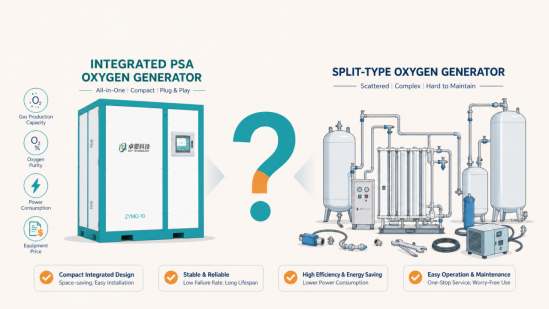
When hospitals compareAll-in-One vs. Split-Type PSA Oxygen Systems: What Are You Really Paying For?
When hospitals compare PSA oxygen systems, the discussion usually starts with flow rate, oxygen purity, power consumption and equipment price.
But once the project reaches installation, the questions become more practical:
Where will the system go? How much space is available? Can the equipment enter the building? How much work will be left for the site team?
This is where the two common architectures—Split-Type and All-in-One—start to show their differences.
The PSA process itself does not change simply because the equipment is integrated. The real difference is how the system is packaged, installed and deployed. WHO technical specifications recognize both skid-mounted and containerized PSA plants as approaches that can facilitate installation.
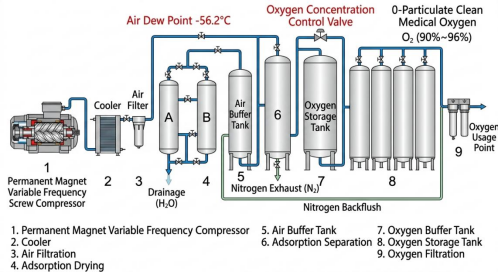
A Split-Type system places the compressor, air treatment equipment, PSA generator and storage tanks separately. Its main advantage is flexibility: engineers can arrange each component around an existing equipment room and site conditions.
That flexibility is particularly useful for large or highly customized projects.
An All-in-One system brings more of these components together into one pre-engineered package.
For example, ZOY's 10 Nm³/h integrated oxygen generator combines the compressor, oxygen generator, storage tank, filters and drying equipment in a footprint of less than 4 m².
For a hospital with limited equipment-room space, that can make a real difference.
There is one important exception: access. A large integrated skid still has to pass through doors, corridors and elevators. In an old hospital renovation with narrow entrances or limited floor loading, separate components may actually be easier to move into place.
This is another clear difference.
With Split-Type equipment, positioning, interconnecting piping, electrical wiring and final system commissioning are largely completed on site.
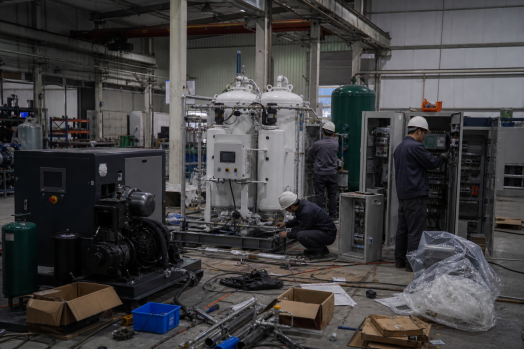
With an All-in-One system, more of this work can be completed and tested before shipment.
The site still needs power, drainage, foundations where required, and connection to the hospital oxygen pipeline. But fewer internal connections have to be built from scratch.
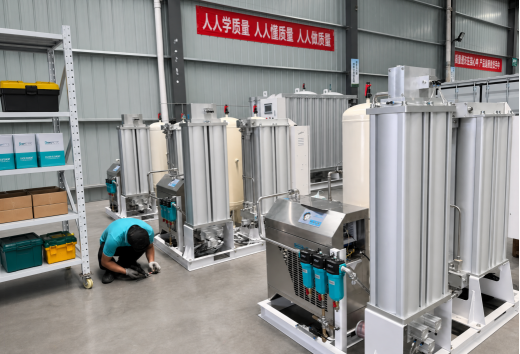
That matters especially for overseas or remote projects, where finding experienced installation and commissioning personnel may take more time.
The benefit is not “zero installation.” It is simply less installation left for the site.
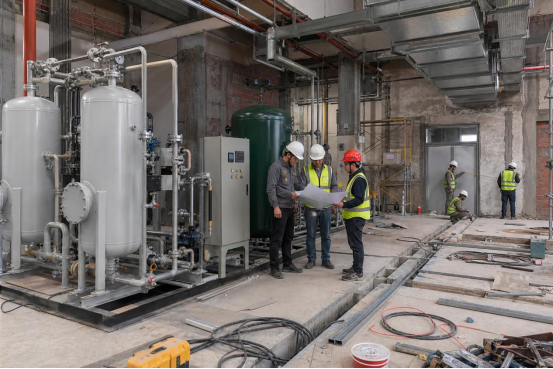
Sometimes the biggest project cost is not the oxygen generator itself, but creating a place to install it.
For outdoor or remote facilities, a containerized system can provide another option.
ZOY's containerized PSA systems use 20GP and 40HQ containers and are designed for outdoor deployment. ZOY's published specifications cover ambient temperatures up to 45°C and high-humidity conditions.
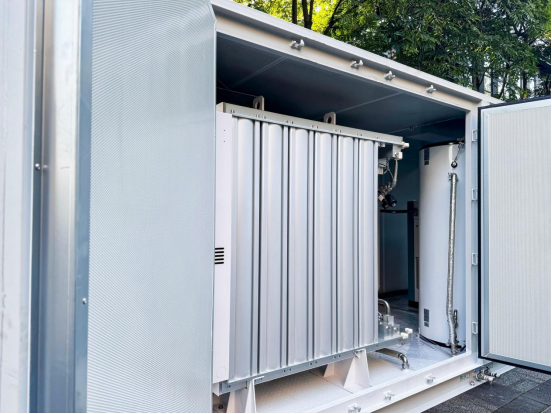
WHO's specifications likewise recognize containerized PSA plants and require appropriate consideration of foundations, utilities, ventilation, maintenance access and safety.
So a container does not mean “no site preparation.”
It means the project may not need to build a conventional oxygen equipment room first.
Integration should not be confused with better PSA performance.
An All-in-One system does not inherently produce higher-purity oxygen or better air treatment than a properly designed Split-Type system. Performance still depends on the compressor, dryers, filters, PSA process, molecular sieve and control system.
The same applies to noise and maintenance.
A compact system must still provide adequate service access. Integration should organize the components—not simply squeeze them together.
This is why the engineering quality of the package matters as much as the fact that it is “integrated.”
If two systems provide the same oxygen capacity, an All-in-One system is not necessarily more expensive because it uses a fundamentally different oxygen-generation technology.
Part of the price is for work completed before delivery:
That makes the choice fairly straightforward.
Choose Split-Type when you have sufficient space, difficult building access, strong local engineering resources or highly customized requirements.
Choose All-in-One when limited space, site installation, civil construction or remote deployment is the bigger challenge.
The question is therefore not simply “Which system is better?”
It is:
How much of the oxygen system do you want to build at the hospital—and how much do you want finished before it arrives?
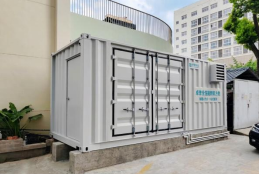
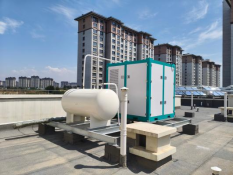
For many projects, that is the real value of All-in-One design: not a different way to produce oxygen, but a more compact and deployment-friendly way to deliver the complete oxygen system.
What is the difference between All-in-One and Split-Type PSA systems?
Split-Type systems install major components separately, while All-in-One systems integrate more components into a pre-engineered package before delivery.
Does All-in-One produce higher-purity oxygen?
Not necessarily. Oxygen purity depends on the complete PSA system design and component selection.
Does All-in-One reduce installation work?
Yes. More internal assembly and connections can be completed before shipment, leaving less work for the site team.
Is Split-Type better for hospital renovations?
It can be, especially when narrow doors, elevators or difficult access make moving a large integrated skid impractical.
Can a containerized PSA system replace a traditional equipment room?
For suitable outdoor projects, it can eliminate the need for a conventional dedicated oxygen building, while foundations, power, drainage, ventilation and safety requirements still need to be addressed.
Founded in 2015 and headquartered in Changsha, China, ZOY Technology specializes in oxygen generation technologies for healthcare and industrial applications. The company integrates research and development, manufacturing, installation, and after-sales service to deliver complete oxygen supply solutions.
Its product portfolio includes PSA medical oxygen generation systems, centralized oxygen supply solutions, integrated oxygen generation stations, industrial oxygen systems, and hyperbaric oxygen chambers. Today, ZOY Technology systems support more than 2,000 healthcare facilities and have been exported to over 60 countries worldwide.
With a strong focus on innovation, ZOY Technology holds multiple core invention patents and continues to invest in advanced oxygen generation technologies. Its solutions have been deployed in hospitals, emergency response projects, railway infrastructure, hospital ships, and regional oxygen supply programs, helping customers build safer, more reliable, and more efficient oxygen supply systems.
By combining scalable system design with long-term operational reliability, ZOY Technology supports healthcare facilities and industrial users throughout every stage of oxygen infrastructure development.
09-30-2026
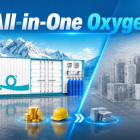
Does an Integrated “All-in-One” Oxygen Machine Really Save on Installation and Engineering Costs?When hospitals compare two PSA oxygen systems, the equipment quotation is usually the easiest part to compare. The more interesting question often comes later: How much work is still left after the equipment arrives on site? A split-type PSA system is not necessarily difficult to install. Experienced oxygen equipment suppliers often provide installation, commissioning and…
09-24-2026
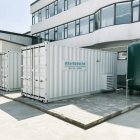
New Oxygen for the “City of the Sage” | Two ZOY Full-Performance Oxygen Shelters Installed at Qufu Second People’s HospitalQufu is known as the hometown of Confucius and the “City of the Sage in the East.” For more than two thousand years, this city has been shaped by Confucian culture and the idea of “benevolence toward others.”That spirit is still very much part of everyday life here. And today, it is also reflected in…
09-24-2026
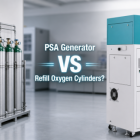
Is It Cheaper for a 50-Bed Clinic in Africa to Refill Oxygen Cylinders or Install a Small On-Site PSA Generator?Why use a 50-bed clinic as the example? Because it sits in an interesting middle ground. A very small clinic may consume too little oxygen to justify its own production system, while a large hospital has more obvious reasons to build dedicated oxygen infrastructure. Around 50 beds, however, the question becomes much more practical: Is…
Submit Request