

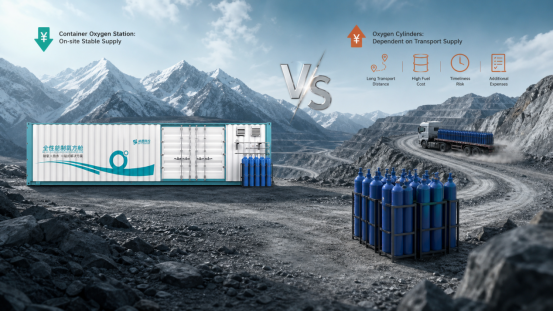
A cylinder may look cheap on paper. At a remote, high-altitude mine, the real cost often starts after the cylinder is purchased.
Transport, loading and unloading, storage, inventory management, supplier coordination—and the risk of delayed deliveries—all become part of the oxygen bill. For a mine operating for years, these recurring costs can matter far more than the price printed on a cylinder.
Gas cylinders still make sense for exploration projects, temporary construction, low or irregular oxygen demand, and emergency backup. The initial investment is relatively low, and there is no need to install an oxygen-generation system onsite.
The calculation changes when oxygen demand becomes steady and deliveries become frequent.
At a remote mine, every delivery depends on roads, vehicles, weather and supply schedules. A longer transport distance does not simply add freight cost; it also makes the supply chain harder to manage.
A containerized PSA oxygen plant takes a different approach. Instead of repeatedly transporting oxygen to the mine, it produces oxygen onsite from compressed ambient air. The cost structure shifts toward electricity, maintenance and site infrastructure.
That does not mean PSA is automatically cheaper. The economics depend on oxygen demand, electricity or diesel costs, transport distance, operating period and site conditions. But when demand is continuous and oxygen logistics are expensive, onsite generation can become considerably more attractive.
Altitude is not just a location detail—it affects how an oxygen plant should be sized and configured.
Lower atmospheric pressure and air density influence compressor performance and system power requirements, so sea-level specifications should not simply be transferred to a high-altitude site.
ZOY’s published containerized PSA specifications provide altitude-specific data. For example, its 10 Nm³/h model is listed at 16.5 kW under standard conditions and 19.25 kW at 4,000 m, with a published ambient range of 0–45°C and 80–95% RH. The point is not the 4,000 m figure itself. It is that altitude needs to be part of the engineering calculation from the beginning.
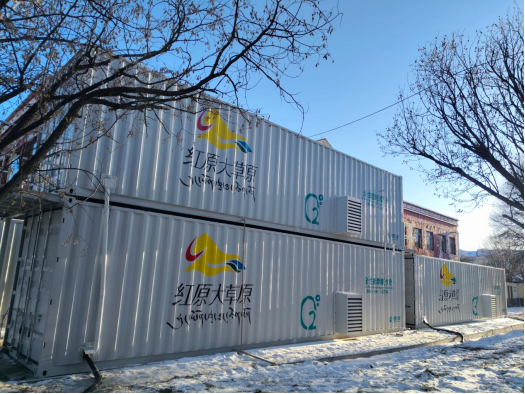
ZOY also has practical high-altitude experience. In 2025, a containerized PSA oxygen generator was deployed at the 3,500 m-high Hongyuan Grassland in Sichuan, China, providing onsite oxygen during a large-scale event.
At a remote mine, energy consumed by oxygen production does not necessarily have to end as waste heat.
ZOY’s containerized systems include heat-recovery options, with published hot-water capacities of 6 tons/day for the 10 Nm³/h model under standard conditions and 7 tons/day at 4,000 m. For the 20 Nm³/h model, the figures are 8.6 and 14 tons/day, respectively.
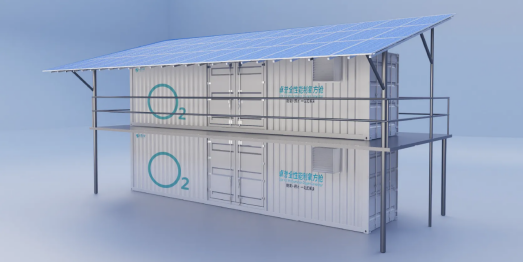
For a mining camp, recovered heat can potentially support hot-water demand for showers, accommodation and other daily operations. Solar PV can also be integrated to supply part of the plant’s electricity demand, with the actual benefit depending on the site’s solar resource, load profile and power costs.
This is where the economics become more interesting: the oxygen plant is no longer viewed only as another power consumer, but as part of a broader site utility system.
There is no universal payback period or transport-distance threshold that works for every mine. The right choice depends on the entire operating environment.
| Cost & Operational Factor | Gas Cylinders | Containerized PSA Plant |
| Initial Investment | Lower | Higher |
| Regular Oxygen Deliveries | Required; ongoing logistics | Greatly reduced |
| Long-Term Steady Demand | Less attractive as logistics accumulate | Can become more attractive over long operating periods |
| Remote-Site Deployment | Highly dependent on roads and supply chain | Onsite production with local power |
| High-Altitude Design | Supplier-dependent | Altitude-specific sizing and configuration |
| Additional Energy Value | None | Heat recovery and solar PV integration possible |
| Backup Strategy | Oxygen stored onsite | Backup power and emergency cylinder stock recommended for critical supply |
For a short-term project or low oxygen demand, cylinders may remain the sensible choice.
For a long-term mine with steady consumption, difficult transportation and suitable power infrastructure, a containerized PSA plant can improve the economics by reducing the need for repeated oxygen deliveries.
And the most resilient solution does not have to be PSA versus cylinders. PSA can serve as the primary oxygen source, while cylinders remain available for emergencies and backup power protects continuity where oxygen supply is critical.
In the end, the better question is not:
“How much does one cylinder cost?”
It is:
“What will it cost to keep oxygen reliably available for the entire operating life of the mine?”
09-02-2026
China’s First Green Electricity Low-Carbon Oxygen Station Officially Commissioned at Hunan Children’s HospitalRecently, China’s first green electricity-powered low-carbon oxygen station was officially commissioned at Hunan Children’s Hospital. As a National Regional Medical Center for Children and a Grade III Class A specialized children’s hospital, the hospital has long placed strong emphasis on its social responsibility, particularly by actively responding to national policies on energy conservation, cost reduction,…
08-28-2026
All-in-One vs. Split-Type PSA Oxygen Systems: What Are You Really Paying For?When hospitals compareAll-in-One vs. Split-Type PSA Oxygen Systems: What Are You Really Paying For? When hospitals compare PSA oxygen systems, the discussion usually starts with flow rate, oxygen purity, power consumption and equipment price. But once the project reaches installation, the questions become more practical: Where will the system go? How much space is available?…

08-20-2026
From the Tibetan Plateau to Africa: How Hunan ZOY Technology Co.,Ltd., an “Invisible Champion” in Oxygen Generation, Broke Through Over a Decade and Carved Out Its Niche in the Trillion Yuan scale MarketAt 2 a.m., a hospital in Hunan is quietly operating as usual. Its oxygen supply system runs around the clock. The equipment comes from Hunan ZOY Technology Co., Ltd., a company based in Changsha Economic and Technological Development Zone. In hospitals, oxygen supply is rarely noticed, yet it cannot stop for a moment. And this…
Submit Request